
By Shireen Akram-Boshar
This article was originally published by Truthout
The visit came amid discussions between the US and Israel about a renewed assault on Iran.
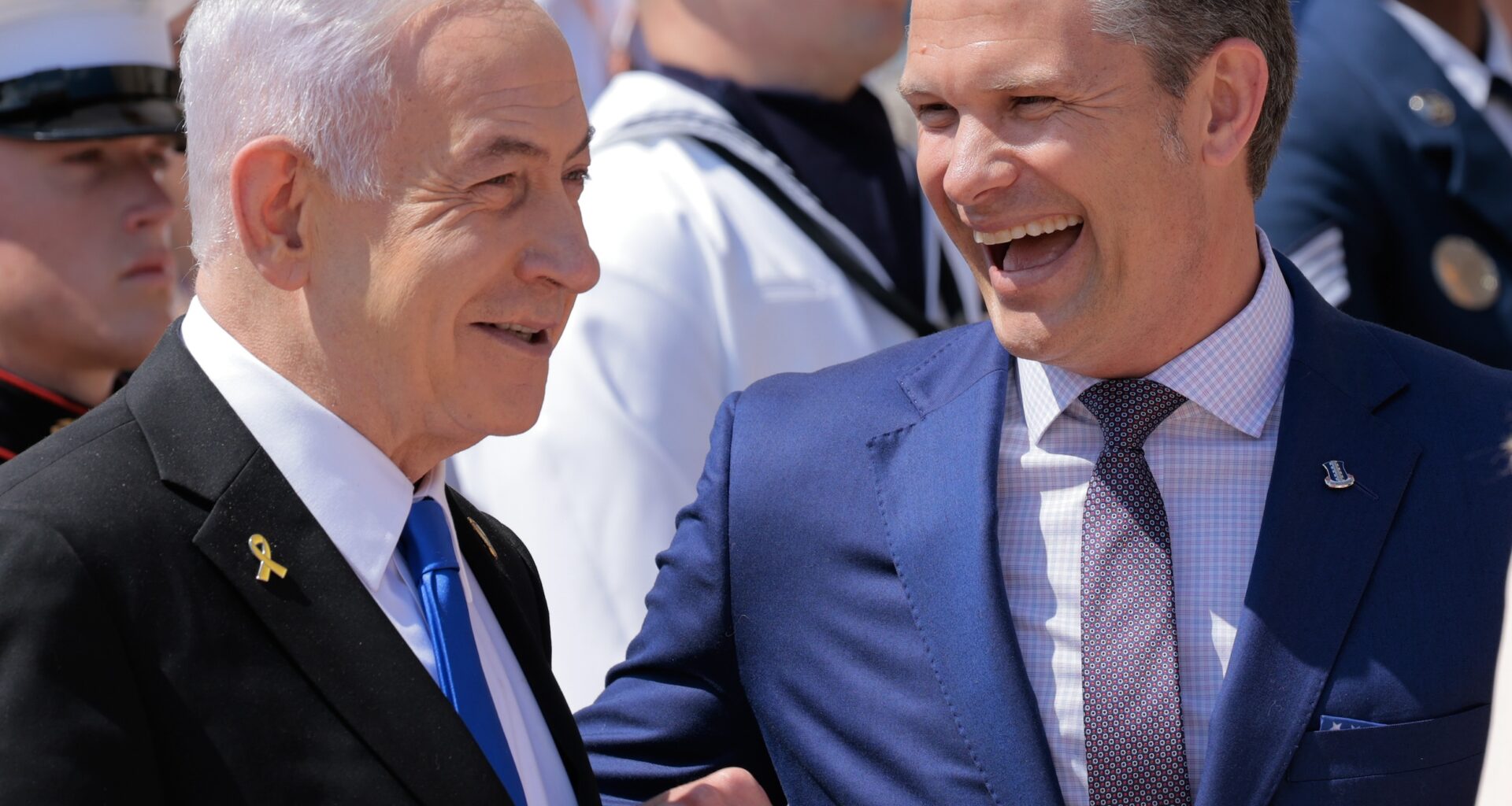
Defense Secretary Pete Hegseth made an unannounced visit to Israel on Monday and met with Israeli Prime Minister Benjamin Netanyahu, just eight days before Israel’s upcoming elections.
On Tuesday, in comments to reporters back in the U.S., Hegseth said that he was there “visiting our troops” and “had a chance to talk to the prime minister,” but that he would not discuss the subject of their meeting.
Hegseth met Netanyahu at the Ovda Air Base in southern Israel.
The visit comes amid discussions between the U.S. and Israel about a renewed assault on Iran. According to The Financial Times, Netanyahu had sought to launch a renewed attack on Iran earlier in October, but Trump dissuaded the attack, stating that it should not occur before the U.S. midterm elections. Hegseth, however, is reportedly among the strongest supporters of renewed strikes on Iran.
Hegseth’s visit came a day after Trump endorsed Netanyahu ahead of Israel’s October 27 elections. In a post on Truth Social, Trump wrote, “If Israel has the wrong Leader, which would be anyone other than Bibi, America will have to do this work ourselves, and I am not inclined to do so.”
But Trump’s endorsement is unlikely to secure a majority for Netanyahu, who has been in power for 19 years — the longest of any Israeli prime minister — and is now facing a highly contested election. According to polling data, the opposition alliance led by Gadi Eisenkot’s Yashar Party is expected to win the most seats in Israel’s election next Tuesday, though no party is expected to secure a majority.
To form a governing coalition, the party with the most seats will need to form a coalition alongside other, smaller parties. But Eisenkot has stated that he would not form a government with Palestinian parties, particularly the Joint List.
In fact, Eisenkot’s “opposition” alliance diverges very little from Netanyahu’s ruling Likud party, particularly when it comes to Palestinians. Eisenkot has announced that he plans to continue to build Israeli settlements in the occupied West Bank, and that he is against a Palestinian state. He has even attempted to position himself to the right of Netanyahu on issues like the E1 settlement project, claiming that Netanyahu has been an obstacle to the project. Eisenkot has also stated his aim to expand the Israeli military by compelling Haredi Jews and Palestinian citizens of Israel to enlist in the army.
Tamir Sorek, professor at Penn State University, said in a recent Institute of Middle East Understanding press briefing that the anti-Netanyahu coalition “shares the same fantasy” of eliminating Palestinians, though “they refuse to articulate it.”
While Netanyahu’s Likud is more consistent and adamant in its attempts to exclude Palestinians from the electoral system, opposition parties like Eisenkot’s have also maneuvered to exclude the Palestinian parties, and to prevent Palestinian citizens of Israel — who make up 20 percent of Israel’s population — from voting.
The United Arab List, however, is seen as more acceptable by Israeli political parties than the Joint List, which consists of the more left-wing parties of Hadash (Jabha in Arabic), Ta’al, and Balad. The Arab List became the first Palestinian party to join an Israeli government in 2021, when Naftali Bennett and Yair Lapid briefly removed Netanyahu from power.
But according to Sorek, a significant difference is that anti-Netanyahu voters are more sensitive to international pressure. “The question of who will be the next prime minister of Israel is secondary to whether the international community will press for sanctions on Israel,” Sorek asserted.
This article was originally published by Truthout and is licensed under Creative Commons (CC BY-NC-ND 4.0). Please maintain all links and credits in accordance with our republishing guidelines.